
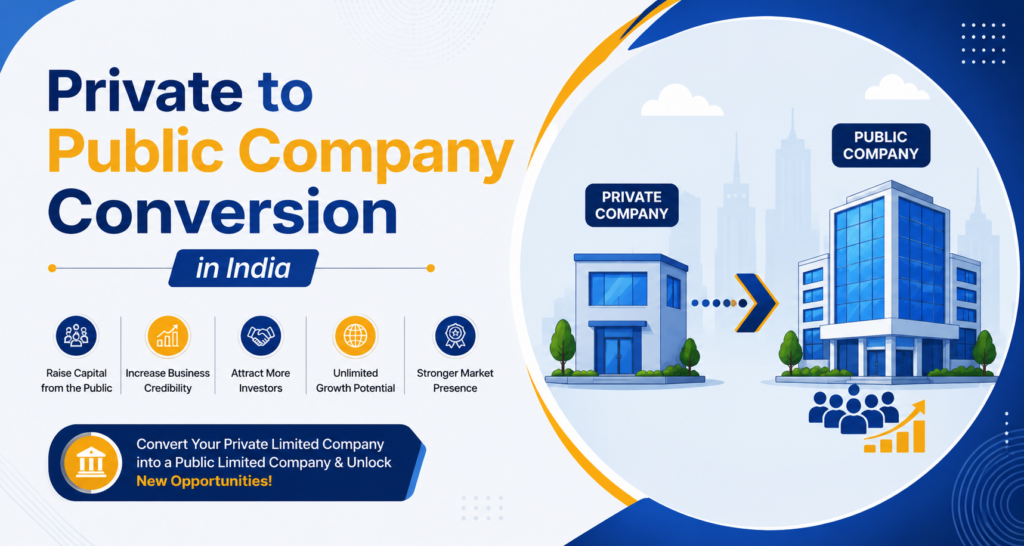
As businesses expand, they often need larger investments, increased credibility, and broader market access. While a Private Limited Company is suitable for closely held businesses, a Public Limited Company provides opportunities for large-scale growth and future fundraising.
Converting a Private Company into a Public Company can be a strategic move for businesses aiming for expansion and long-term success.
When Should You Convert a Private Company into a Public Company?
Many businesses start as Private Limited Companies but eventually outgrow the structure.
You should consider conversion when:
Need Help with Business & Legal Registration?
Talk to our expert today for free consultation
📞 Call Now- Your business requires substantial capital.
- You plan to attract institutional investors.
- You want greater market visibility.
- You intend to prepare for future public fundraising.
- Your company is expanding rapidly.
Key Differences Between Private and Public Companies
| Particulars | Private Company | Public Company |
|---|---|---|
| Minimum Shareholders | 2 | 7 |
| Minimum Directors | 2 | 3 |
| Maximum Members | 200 | Unlimited |
| Share Transfer | Restricted | Freely Transferable |
| Public Fundraising | Not Allowed | Allowed |
| Business Credibility | Moderate | High |
Major Advantages of Conversion
Key Benefits of Converting a Private Company into a Public Company
Capital Raising
Access a wider pool of investors and funding opportunities.
Corporate Image
Enhance business credibility and market reputation.
Unlimited Members
No restriction on the maximum number of shareholders.
Business Expansion
Raise larger funds to support growth and expansion plans.
Investor Confidence
Attract investors through transparency and governance.
Eligibility Criteria
Before starting the conversion process:
✔ Minimum 7 shareholders
✔ Minimum 3 directors
✔ Updated ROC filings
✔ No major compliance defaults
✔ Shareholder approval through Special Resolution
Documents Required for Conversion
The following documents are generally required:
- Certificate of Incorporation
- PAN of Company
- MOA & AOA
- Board Resolution
- Special Resolution
- Financial Statements
- Directors’ KYC Documents
- Shareholder Details
- DSC of Directors
- DIN Details
Private to Public Company Conversion Process
Board Meeting
Approve conversion proposal.
Shareholder Approval
Conduct general meeting.
Special Resolution
Members approve conversion.
MOA & AOA
Amend company documents.
ROC Filing
Submit required forms.
ROC Verification
Documents reviewed.
Fresh Certificate
New certificate issued.
Compliance Requirements After Conversion
After becoming a Public Company, businesses must ensure:
- Annual ROC Compliance
- Annual General Meetings (AGM)
- Board Meetings
- Statutory Audit
- Income Tax Compliance
- Maintenance of Company Records
Common Challenges During Conversion
Avoid these common mistakes to ensure a smooth Private to Public Company conversion process.
Documentation Delay
Missing or incomplete documents can significantly slow down the approval process.
Incorrect ROC Filing
Errors in forms or submissions may lead to rejection or resubmission.
MOA & AOA Issues
Improper amendments can create compliance and legal complications.
Compliance Backlog
Pending ROC filings and unresolved compliance issues may delay approval.
Is Private to Public Conversion Right for Your Business?
Conversion may be beneficial if your company:
- Is experiencing rapid growth.
- Needs significant funding.
- Plans future public investment opportunities.
- Wants stronger market recognition.
- Seeks long-term scalability.
Need Help with Private to Public Company Conversion? 🚀
Conclusion
Private to Public Company Conversion is an important milestone for growing businesses. It opens doors to larger funding opportunities, increased credibility, and long-term expansion. With proper planning, documentation, and compliance, the conversion process can be completed smoothly while positioning the business for future growth and success.