


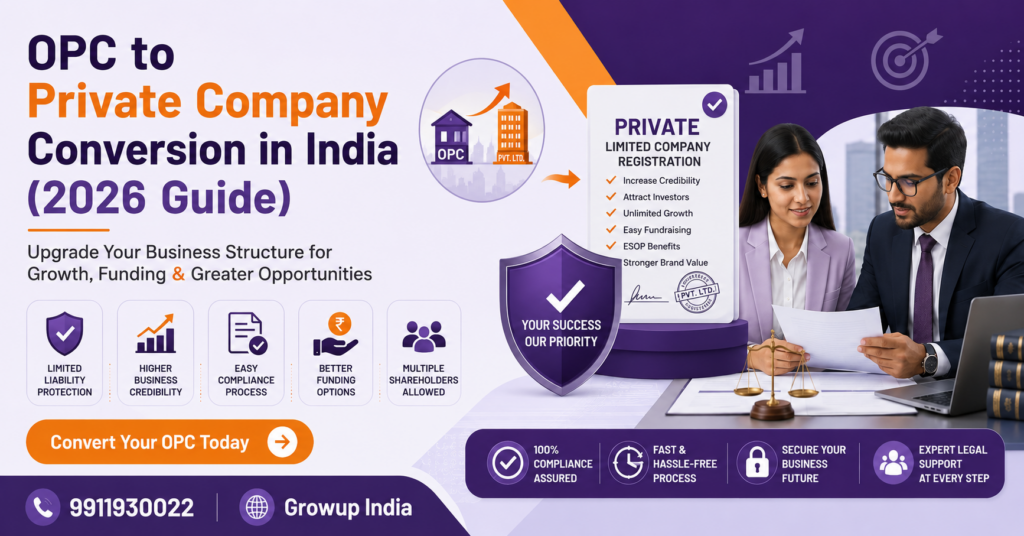
If your business is growing, an OPC (One Person Company) may start feeling limited. While OPC is great for solo entrepreneurs, it restricts ownership and funding opportunities.
That’s where conversion to a Private Limited Company becomes important.
A Private Limited structure helps you scale faster, attract investors, and build stronger market credibility. In this guide, you’ll understand the complete conversion process in a simple and structured way.
Understanding OPC and Private Limited Company
What is OPC?
An OPC (One Person Company) is a business structure under the Companies Act, 2013, where one person owns and manages the company with limited liability protection.
Need Help with Business & Legal Registration?
Talk to our expert today for free consultation
📞 Call NowIt is ideal for:
- Freelancers
- Solo entrepreneurs
- Small business owners
Start Your OPC to Private Company Conversion 🚀
What is a Private Limited Company?
A Private Limited Company is a corporate structure where ownership is divided among multiple shareholders.
It offers:
- Better scalability
- Easier funding options
- Higher business credibility
- More flexibility in ownership
Why Convert OPC to Private Limited Company?
Key Benefits of Converting Your OPC into a Private Limited Company
Business Growth
Expand your business efficiently with multiple shareholders and better scalability.
Investor Funding
VCs, angel investors and banks prefer Private Limited Companies.
Strong Market Image
Enhance trust, reputation and professional credibility.
No Ownership Limit
Add up to 200 shareholders for future business expansion.
Employee Benefits
Offer ESOPs and attractive benefits to retain top talent.
Eligibility for Conversion
Before converting OPC into a Private Limited Company, ensure:
- OPC has completed minimum 2 years OR meets turnover requirements
- At least 2 directors and 2 shareholders are available
- All ROC filings are completed and updated
- No compliance defaults under MCA
Documents Required
Here is the list of important documents:
- PAN Card of directors/shareholders
- Aadhaar Card
- Digital Signature Certificate (DSC)
- OPC Incorporation Certificate
- MOA (Memorandum of Association)
- AOA (Articles of Association)
- Financial statements
- Board resolution
- NOC (if required)
OPC to Private Company Conversion Process
Board Approval
Pass board resolution.
Add Members
Add director & shareholder.
Name Reservation
Apply via MCA RUN.
MCA Filing
Submit forms.
MOA & AOA
Update documents.
ROC Verification
ROC checks filings.
Final Approval
Certificate issued.
Benefits After Conversion
Once your OPC becomes a Private Limited Company, you get:
- Easier business expansion
- Access to investors and funding
- Stronger brand credibility
- Limited liability protection
- Better compliance structure
- Long-term scalability
Post Conversion Compliance
Annual ROC Filings
File annual returns and financial statements with ROC.
Board Meetings
Conduct a minimum of 4 board meetings every year.
Statutory Audit
Maintain audit compliance as per Companies Act.
Income Tax Returns
File company income tax returns within due dates.
Statutory Registers
Maintain and update all mandatory company records.
Common Mistakes to Avoid
Be careful and avoid:
- Not adding required directors/shareholders
- Missing ROC filing deadlines
- Incorrect legal drafting of MOA/AOA
- Ignoring compliance backlog
Start Your OPC to Private Company Conversion 🚀
Conclusion
Converting an OPC into a Private Limited Company is a smart decision for business growth and expansion. It helps you attract investment, build credibility, and scale your business efficiently.
With proper documentation and compliance, the conversion process is smooth and highly beneficial for long-term success.