
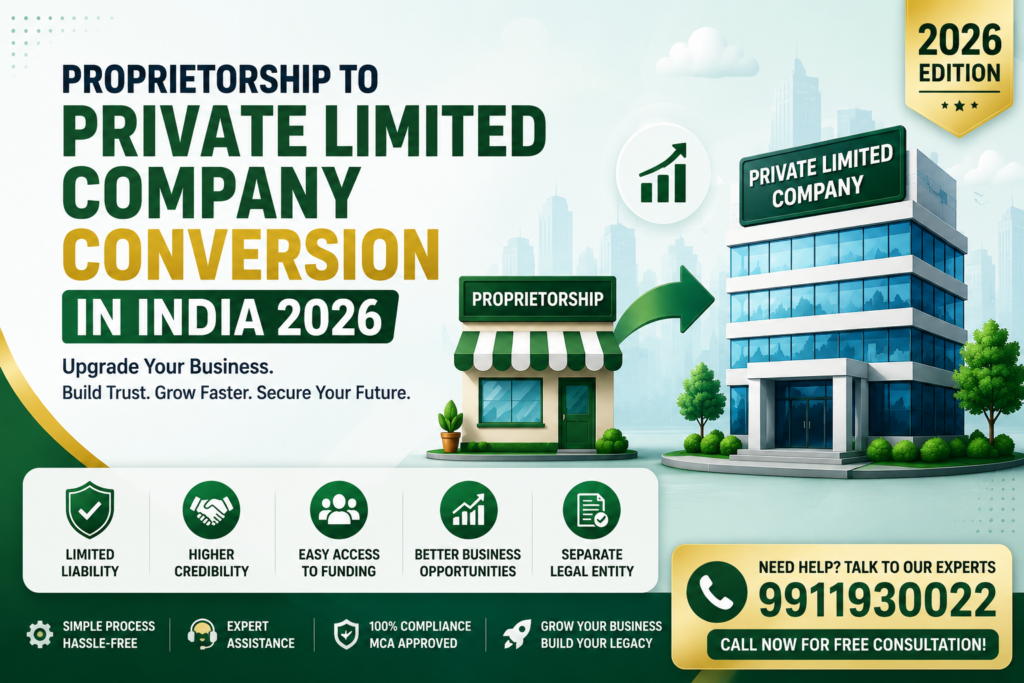
Is Your Proprietorship Business Holding Back Your Growth?
Starting a business as a sole proprietor is often the easiest option. There is minimal paperwork, fewer compliance requirements, and complete control remains with the owner.
However, as the business grows, many entrepreneurs start facing challenges that a proprietorship structure cannot solve.
For example:
- Corporate clients prefer dealing with registered companies.
- Investors cannot invest directly in a proprietorship.
- Business loans become difficult to secure.
- Personal assets remain exposed to business liabilities.
- Expansion opportunities become limited.
If your business is experiencing any of these situations, it may be the right time to convert your proprietorship into a Private Limited Company.
Need Help with Business & Legal Registration?
Talk to our expert today for free consultation
📞 Call NowA Private Limited Company provides a stronger legal structure, greater credibility, and better opportunities for long-term growth.
Why Business Owners Are Switching to Private Limited Companies
Imagine your business has started receiving larger orders and attracting bigger clients.
Everything seems positive until clients begin asking questions such as:
“Is your business registered as a company?”
“Can you share your company profile?”
“Do you have multiple directors?”
These questions are becoming increasingly common because many organizations prefer working with registered companies rather than individual proprietors.
Converting to a Private Limited Company helps create a more professional image while providing additional legal and financial benefits.
What is Proprietorship to Private Limited Company Conversion?
Simply put, it is the process of shifting an existing proprietorship business into a newly incorporated Private Limited Company.
Instead of operating as an individual owner, the business starts operating through a company structure regulated under the Companies Act, 2013.
The business activities may remain the same, but the legal structure becomes stronger and more scalable.
When Should You Convert Your Proprietorship?
| Situation | Why Conversion Makes Sense |
|---|---|
| 📈 Revenue is Increasing | Growing businesses often require a stronger legal structure to support expansion, funding opportunities, and operational growth. |
| 💰 Investors Show Interest | Private Limited Companies can issue shares, making it easier to attract investors and raise capital. |
| 🛡️ Need Limited Liability Protection | A company structure separates personal assets from business liabilities, reducing personal financial risk. |
| 🏢 Corporate Clients Are Increasing | Many large organizations and government bodies prefer working with registered Private Limited Companies. |
| 🚀 Building a Long-Term Brand | A Private Limited Company offers better credibility, continuity, and market reputation for long-term success. |
Key Benefits of Proprietorship to Private Limited Company Conversion
Enhanced Business Credibility
A Private Limited Company often creates greater trust among customers, vendors, investors, and financial institutions.
Limited Liability Protection
The liability of shareholders is limited to their investment in the company.
Separate Legal Identity
The company becomes an independent legal entity capable of owning assets and entering contracts.
Easier Access to Funding
Private Limited Companies can attract investors, venture capital firms, and financial institutions more easily.
Better Business Continuity
The company continues to exist even if ownership changes in the future.
Improved Brand Value
A registered company generally appears more professional and reliable in the marketplace.
Convert Your Proprietorship into a Private Limited Company 🚀
Documents Required for Conversion
To convert a proprietorship into a Private Limited Company, the following documents are generally required:
Director Documents
- PAN Card
- Aadhaar Card
- Passport Size Photograph
- Email Address
- Mobile Number
- Address Proof
Registered Office Documents
- Electricity Bill
- Rent Agreement (if applicable)
- NOC from Property Owner
Existing Business Documents
- GST Registration Certificate
- Business Licenses
- Bank Account Details
- Financial Records (if applicable)
Step-by-Step Conversion Process
Obtain DSC
Digital Signature Certificates for directors.
Apply DIN
Get Director Identification Numbers.
Name Approval
Reserve company name with MCA.
Incorporate Company
File incorporation documents online.
Get COI
Receive Certificate of Incorporation.
Transfer Assets
Move assets and business operations.
Update Records
Update GST, bank accounts & licenses.
How Much Does Conversion Cost?
The total cost depends on factors such as:
- Government fees
- Digital Signature Certificates
- Professional fees
- Documentation requirements
For most businesses, the conversion cost generally ranges between ₹10,000 and ₹50,000.
The actual amount may vary depending on the business structure and specific requirements.
Proprietorship vs Private Limited Company
| Particulars | Proprietorship | Private Limited |
|---|---|---|
| Legal Identity | No Separate Identity | Separate Legal Entity |
| Liability | Unlimited | Limited |
| Funding Options | Limited | Better Access |
| Investor Friendly | No | Yes |
| Business Continuity | Depends on Owner | Perpetual Succession |
| Market Credibility | Moderate | High |
Common Mistakes Business Owners Make During Conversion
Many businesses face delays because of:
- Incorrect documentation
- Improper company name selection
- Compliance mistakes
- Incomplete asset transfer planning
Proper planning and professional assistance can help ensure a smooth conversion process.
Convert Your Proprietorship into a Private Limited Company 🚀
Get expert assistance for company conversion, MCA filing, documentation, and compliance support.
Get Free ConsultationIs Conversion Worth It?
If your business is growing and you want to build a stronger brand, attract investors, improve credibility, and protect personal assets, converting into a Private Limited Company can be a valuable step.
While a proprietorship is ideal for starting a business, a Private Limited Company is often better suited for long-term growth and expansion.
Need Professional Assistance?
Every business has unique requirements. Before starting the conversion process, it is important to understand the legal, tax, and compliance implications involved. To learn more about our experience, visit our About Us page or contact our team for professional guidance.
Frequently Asked Questions
Everything you need to know about Proprietorship to Private Limited Company Conversion.
Yes. The proprietor can become both a director and shareholder of the newly incorporated Private Limited Company.
Yes. Business operations can continue while transitioning from a proprietorship to a Private Limited Company.
In most cases, the conversion process takes around 10–20 working days, depending on documentation and MCA approvals.
A similar business name may be approved, subject to MCA name availability and approval guidelines.
No. However, conversion is often beneficial for businesses seeking funding, expansion, investor participation, and improved credibility.