

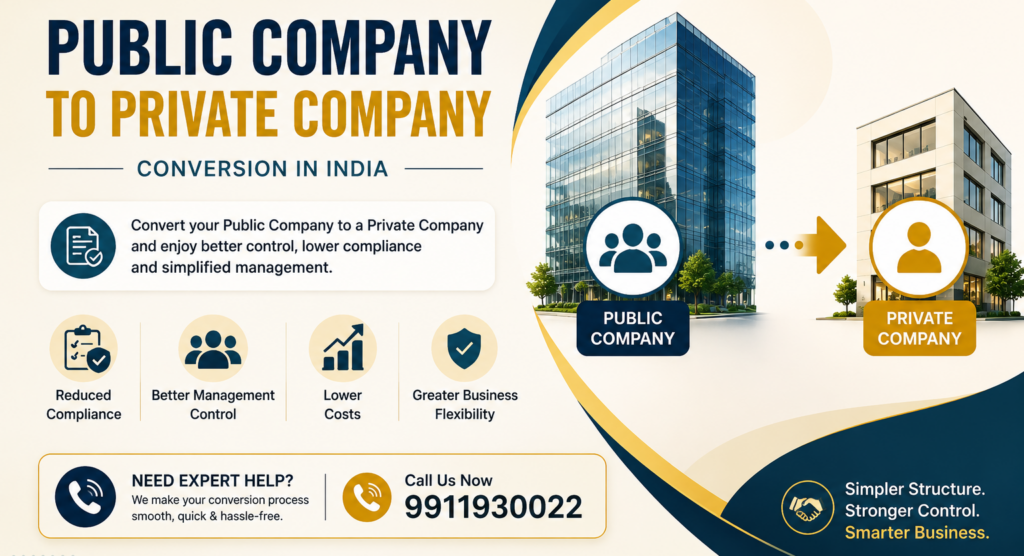
Is your Public Limited Company facing increasing compliance requirements, higher administrative costs, and complex regulatory obligations?
While a Public Company structure is ideal for raising capital and attracting investors, it may not always be the most practical choice for every business. As business priorities change, many companies prefer a more flexible and controlled corporate structure.
This is where Public Company to Private Company Conversion becomes valuable.
By converting into a Private Limited Company, businesses can reduce compliance burdens, simplify management, and gain greater control over ownership and decision-making.
Need Help with Business & Legal Registration?
Talk to our expert today for free consultation
📞 Call NowIn this guide, you’ll learn the complete conversion process, eligibility requirements, documents needed, benefits, and post-conversion compliance requirements.
What is a Public Company?
Key Features of a Public Limited Company
A Public Limited Company can have unlimited shareholders and follows higher compliance and governance requirements.
7 Shareholders
Minimum requirement.
3 Directors
Mandatory management structure.
High Compliance
More filings & regulations.
Public Funding
Easier access to capital.
What is a Private Company?
A Private Limited Company is a privately held business structure with restricted share transfers and a limited number of shareholders.
Key Features:
- Minimum 2 shareholders
- Minimum 2 directors
- Restricted share transfers
- Reduced compliance burden
- Better ownership control
Why Convert a Public Company into a Private Company?
Top Benefits of Converting Your Public Limited Company into a Private Limited Company
Reduced Compliance
Private Companies have fewer regulatory and compliance requirements than Public Companies.
Better Management Control
A smaller shareholder base allows faster decisions and stronger promoter control.
Lower Compliance Costs
Reduce expenses related to governance, reporting, audits, and legal compliance.
Business Flexibility
Implement strategic business decisions quickly and adapt to changing market conditions.
Enhanced Confidentiality
Enjoy greater privacy and keep sensitive business information more confidential.
Eligibility for Conversion
Before initiating the conversion process, ensure:
- Shareholders approve the conversion proposal.
- The company has completed all pending ROC filings.
- Articles of Association (AOA) can be amended as per Private Company requirements.
- There are no major regulatory or compliance defaults.
- Necessary corporate approvals have been obtained.
Documents Required
The following documents are commonly required:
- Certificate of Incorporation
- Company PAN Card
- Memorandum of Association (MOA)
- Articles of Association (AOA)
- Board Resolution
- Special Resolution
- Shareholder List
- Director KYC Documents
- Digital Signature Certificates (DSC)
- Latest Financial Statements
- ROC Filing Documents
Step-by-Step Conversion Process
Public Company to Private Company Conversion Procedure in India
Board Approval
The Board approves the proposal for conversion.
Shareholder Approval
Conduct a General Meeting and obtain consent.
Special Resolution
Members approve conversion through a Special Resolution.
Amend MOA & AOA
Modify company documents as per Private Company rules.
ROC Filing
Submit forms, resolutions and supporting documents.
ROC Verification
Registrar reviews documents and compliance records.
Fresh Certificate
Receive new Certificate of Incorporation from ROC.
Benefits After Conversion
Once converted into a Private Limited Company, businesses can enjoy:
- Reduced compliance burden
- Faster business decisions
- Better management control
- Lower administrative costs
- Improved operational flexibility
- Greater confidentiality
Need Help with Public Company to Private Company Conversion?
Post Conversion Compliance
After conversion, companies must continue to comply with:
- Annual ROC Filings
- Income Tax Return Filing
- Statutory Audit Requirements
- Board Meetings
- Maintenance of Statutory Registers
- Financial Statement Filing
Common Challenges During Conversion
Avoid these common mistakes to ensure a smooth Public Company to Private Company Conversion.
Documentation Delays
Missing or incomplete documents can significantly slow down the approval process.
ROC Filing Errors
Incorrect forms or inaccurate information may lead to rejection or resubmission.
AOA Amendment Issues
Improper drafting of Articles of Association may create compliance complications.
Pending Compliance
Unresolved filings or regulatory issues can delay conversion approval.
Conclusion
Converting a Public Company into a Private Company can be a strategic decision for businesses seeking greater control, lower compliance costs, and improved operational flexibility.
With proper planning, accurate documentation, and timely regulatory filings, the conversion process can be completed smoothly, allowing businesses to focus on growth and long-term success. 🚀
Need Help? 🚀
Need assistance with Public Company to Private Company Conversion? Our experts can help with documentation, ROC filing and approvals.
Get Expert Help