


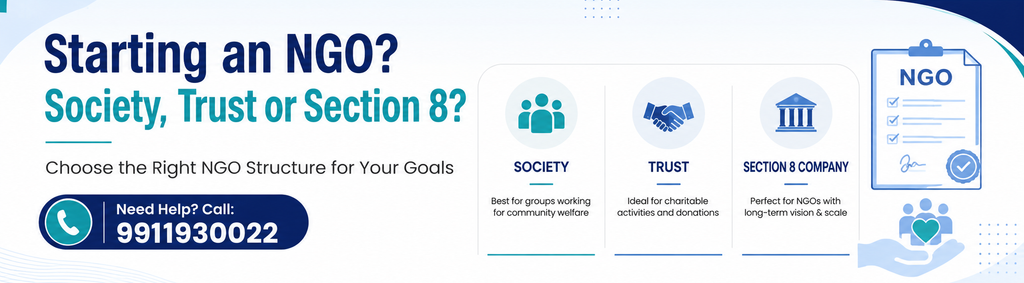
Starting an NGO in India is a great way to work for a social cause. You may want to support education, healthcare, women, children, animals, or rural communities. But there is one important decision to make first. Should you register your NGO as a Society, Trust, or Section 8 Company?
Choose the Right NGO Structure
Society, Trust or Section 8 Company? Get help choosing the right structure for your NGO.
Each structure has different rules, management systems, and compliance requirements. Therefore, choosing the right option at the beginning can save you time and effort later. In this guide, we compare all three options in simple language. By the end, you will have a clearer idea of which NGO structure may suit your goals.
Society, Trust or Section 8 Company: Quick Comparison
Here is a simple comparison to help you understand the basic difference.
Need Help with Business & Legal Registration?
Talk to our expert today for free consultation
📞 Call Now| Factor | Society | Trust | Section 8 Company |
|---|---|---|---|
| Main purpose | Social and charitable activities | Charitable activities | Non-profit activities |
| Management | Governing body | Trustees | Board of Directors |
| Best suited for | Member-based NGOs | Founder-led charities | Structured and professional NGOs |
| Compliance | Moderate | Varies by law and state | Generally higher |
| Corporate structure | No | No | Yes |
| Suitable for growth | Yes | Yes | Yes |
| Donor confidence | Good | Good | Often strong |
| Registration law | State-specific law | Applicable trust law | Companies Act, 2013 |
The exact rules can vary depending on the state, activities, and legal structure. So, do not choose an NGO structure only by looking at registration cost. Your long-term plans also matter.
Choose a Society If You Want a Member-Based NGO
A Society can be a good option when several people want to work together for a common social purpose.
For example, a group may start an organisation for education, healthcare, rural development or community welfare.
A Society is generally managed by a governing body.
Why Choose a Society?
A Society may suit you if:
- You have several active members.
- You want members to participate in decisions.
- Your NGO will involve community participation.
- You want a member-based structure.
- You plan to conduct social activities with a group of people.
Benefits of a Society
A Society allows several people to participate in management.
It can also work well for community-based organisations.
The structure is familiar to many NGOs in India.
However, you should consider the compliance requirements of the state where you plan to register the Society.
Things to Consider
A Society may not be the best choice for everyone.
You may need a larger group of members. Disagreements between members can also affect decision-making.
Therefore, make sure the founders understand their roles before registration.
Choose a Trust If You Want a Simple Charitable Structure
A Trust is another popular option for starting a charitable organisation. A Trust is generally created through a trust deed. The deed explains the purpose of the Trust and the role of the trustees.
This structure can work well when a small group wants to manage charitable activities.
Why Choose a Trust?
A Trust may suit you if:
- You have a small group of founders.
- You want trustees to manage the organisation.
- Your main goal is charitable work.
- You want a focused management structure.
- You have clear long-term charitable objectives.
Benefits of a Trust
A Trust can offer a simple management structure. The trustees are responsible for managing the organisation according to the trust deed. This can make a Trust suitable for founder-led charitable activities. It can also be useful for organisations that want to focus on long-term charitable objectives.
Things to Consider
The rules for Trust registration can vary depending on the applicable law and state. The trust deed is also very important. It should clearly explain the objectives, powers, duties, and management of the Trust. Therefore, avoid using a poorly drafted trust deed.
Choose a Section 8 Company If You Want a Professional Structure
A Section 8 Company is a non-profit company registered under the Companies Act, 2013.
It can be formed for charitable and social objectives.
These objectives may include education, healthcare, social welfare, environmental protection, research and sports.
A Section 8 Company has a formal corporate structure.
Why Choose a Section 8 Company?
A Section 8 Company may suit you if:
- You want a professional structure.
- You plan to work with institutions.
- You want clear corporate governance.
- You expect the organisation to grow.
- You may seek institutional funding.
- You want a structured management system.
Benefits of a Section 8 Company
A Section 8 Company provides a clear corporate framework.
It has defined roles for directors and members.
It can create a professional image when working with companies, institutions and other organisations.
Its governance and reporting requirements are also clearly defined under company law.
Things to Consider
The main point to consider is compliance.
A Section 8 Company has formal corporate requirements. These requirements can be higher than those of some smaller charitable organisations.
You may need to manage:
- Annual filings
- Financial statements
- Board meetings
- Statutory records
- Audit requirements
- Director compliance
Therefore, you should be prepared for regular legal and financial compliance.
Which NGO Structure Is Best for You?
There is no single structure that is best for every NGO. Your choice should depend on your goals.
Choose a Trust If You Are Starting Small
A Trust may be suitable if you have a small group of founders and want to focus on charitable activities. It can provide a focused management structure through trustees.
Choose a Society If You Have Several Members
A Society can be suitable when several people want to participate in the organisation. It is often useful for member-based and community-focused activities.
Choose a Section 8 Company If You Want to Grow
A Section 8 Company can be a good choice if you want a formal structure from the beginning. It may suit NGOs that plan to work with companies, institutions, donors, or large projects.
What About 12AB, 80G and CSR Funding?
NGO registration is only the beginning.
You may also need additional registrations or approvals based on your activities and funding plans.
12AB Registration
Eligible charitable organisations can apply for tax exemption under the applicable provisions.
The current tax rules and registration requirements should be checked before applying.
80G Approval
Eligible NGOs may apply for 80G approval.
This can help qualifying donors claim tax benefits on eligible donations.
However, approval is subject to the applicable rules.
CSR Funding
Some NGOs may also work with companies for CSR projects.
A Society, Trust or Section 8 Company may qualify in the right circumstances.
However, NGO registration alone does not guarantee CSR funding.
The organisation must meet the applicable CSR requirements and maintain proper records.
Society vs Trust vs Section 8: Cost, Compliance and Management
Cost is an important factor when starting an NGO. However, it should not be the only factor. A cheaper registration may still create problems if the structure does not match your future plans.
Registration Cost
The registration cost can vary based on the structure, state, professional fees, and government charges. Therefore, there is no single fixed cost for every NGO. Before starting the process, check the applicable government fees and professional charges.
Ongoing Compliance
A registered NGO must maintain proper records. The exact compliance depends on the structure and applicable laws. A Section 8 Company generally has more formal corporate compliance.
A Society and Trust also have ongoing legal and financial requirements. These can vary by state and structure.
Management
Management is another major difference. A Society is managed through its members and governing body.
A Trust is managed by trustees. A Section 8 Company is managed by directors and members. Choose the structure that matches the way you want to make decisions.
Documents Required for NGO Registration
The documents required for NGO registration depend on the type of NGO you choose.
However, some documents are commonly required.
- PAN and identity proof of founders
- Address proof
- Passport-size photographs
- Registered office proof
- Office address NOC, where required
- Trust deed for a Trust
- Memorandum and rules for a Society
- MOA and AOA for a Section 8 Company
- Details of members, trustees or directors
- Details of the NGO’s objectives
Additional Documents
Additional documents may be required based on the registration type and state.
Therefore, prepare the documents carefully before starting the application.
Society vs Trust vs Section 8 Company: What Is the Difference?
The main difference is how the organisation is formed and managed. A Society is generally managed by members through a governing body. A Trust is managed by trustees according to the trust deed.
A Section 8 Company is managed through members and directors under the Companies Act, 2013. The right option depends on how you want to run your NGO.
Management Structure
A Society usually works through a group of members. The members can participate in important decisions. This makes a Society suitable for organisations with active community participation. A Trust is managed by trustees. The trust deed explains the powers and responsibilities of the trustees. This can make the management structure more focused.
A Section 8 Company has a formal corporate structure. Its management is handled by directors and members. It also follows company law requirements.
Number of Founders
The number of founders can also affect your decision. A Society generally requires a group of members. In many cases, seven or more members are required for registration.
A Trust can often be created by a smaller group of people. However, the exact requirements can depend on the applicable law. A Section 8 Company can generally be formed with two members and two directors for a private company structure. Always check the current requirements before registration.
Compliance Requirements
Every registered NGO has some level of compliance. However, the type and level of compliance can be different. A Trust may have relatively simple management requirements in some cases. A Society may need regular records and filings under the applicable state law.
A Section 8 Company follows company law compliance. This can include annual filings, financial statements, board meetings, and other statutory requirements. Therefore, consider your ability to manage ongoing compliance before choosing a structure.
Common Mistakes When Starting an NGO
Starting an NGO involves more than submitting a registration application.
Avoid these common mistakes.
1. Choosing the Structure Only by Cost
Do not choose an NGO structure simply because it appears cheaper.
First, consider your long-term objectives.
2. Writing Unclear Objectives
Your NGO objectives should clearly explain the social activities you plan to undertake.
Avoid vague or unrelated objectives.
3. Ignoring Future Compliance
Registration does not mean your legal responsibilities are finished.
You may have annual filings, accounting, tax and other compliance requirements.
4. Poor Record Keeping
Maintain proper records from the beginning.
Keep documents related to donations, expenses, meetings, accounts and activities.
5. Not Planning for Funding
If you plan to receive donations, grants or CSR funding, consider the related requirements early.
This can help you avoid problems later.
6. Choosing the Wrong Management Structure
Think about who will manage the NGO.
If several members will participate, a Society may work better.
If trustees will manage the organisation, a Trust may be more suitable.
If you want a corporate governance model, consider a Section 8 Company.
Final Recommendation: Which NGO Structure Should You Choose?
Choosing between a Society, Trust, and Section 8 Company depends on your goals. A Trust can be suitable for a small, founder-led charitable organisation.
A Society can be suitable for a member-based NGO with several active members. A Section 8 Company can be suitable for an NGO that wants a formal corporate structure and professional governance.
Before making a decision, compare the registration process, management structure, compliance, funding plans, and long-term goals. The right structure can make your NGO easier to manage as it grows. If you are unsure which option is suitable, take professional advice before registration.
Frequently Asked Questions
Is a Section 8 Company better than a Trust?
Not always.
A Section 8 Company may be better for a structured and professional organisation. A Trust may be more suitable for a smaller charitable organisation.
The right choice depends on your goals.
Is a Society better than a Trust?
It depends on how you want to manage your NGO.
A Society may be suitable for a member-based organisation. A Trust may work better when trustees will manage the organisation.
Which NGO structure has less compliance?
The compliance burden depends on the structure and applicable laws.
A Section 8 Company generally has more formal corporate compliance. Trust and Society compliance can vary based on state laws and activities.
Can an NGO receive donations?
Yes.
Eligible NGOs can receive donations. However, tax approvals and other requirements may apply depending on the donation and the organisation.
Can NGOs receive CSR funding?
Yes, an eligible NGO may receive CSR funding if it meets the applicable requirements.
However, registration as a Society, Trust or Section 8 Company does not automatically guarantee CSR funding.
Which NGO structure is best for a new NGO?
There is no universal answer.
Choose a Trust for a small founder-led charitable organisation.
Choose a Society for a member-based organisation.
Choose a Section 8 Company for a more formal and structured non-profit organisation.
The best choice is the one that matches your current needs and future plans.