
Starting a business in India is an exciting opportunity, but choosing the right business structure and completing the required legal registrations are essential for long-term success. Whether you are launching a startup, opening a retail store, providing professional services, or expanding an existing business, proper registration gives your business a legal identity and helps you operate with confidence.
From selecting the right entity type to obtaining registrations like GST and MSME, every business must follow specific legal procedures. Understanding these requirements at the beginning can help you avoid compliance issues, reduce legal risks, and build a strong foundation for growth.
In this complete guide, you’ll learn about the different types of business registrations in India, required documents, registration process, legal compliances, and post-registration requirements. You’ll also find links to detailed guides for each registration, making it easy to explore the topic in depth.
Need Help with Business & Legal Registration?
Talk to our expert today for free consultation
📞 Call NowWhat is Business Registration?
Business registration is the legal process of establishing a business under the applicable laws in India. It provides your business with official recognition and allows you to operate legally, open a business bank account, apply for government registrations, enter into contracts, and build trust with customers and financial institutions.
The registration process depends on the type of business you choose. Popular business structures include Private Limited Company, LLP, One Person Company (OPC), Partnership Firm, Proprietorship Firm, Section 8 Company, and Producer Company. Each structure has different legal requirements, tax implications, and compliance obligations.
This guide will help you understand which registration is suitable for your business and what additional registrations may be required as your business grows.
Why is Business Registration Important?
Registering your business offers several legal and financial advantages, including:
- Legal Recognition: Operate your business under the applicable laws of India.
- Limited Liability Protection: Certain business structures protect the personal assets of business owners.
- Business Credibility: Build trust with customers, banks, suppliers, and investors.
- Business Expansion: A registered business can more easily secure funding, enter into contracts, participate in government tenders, and expand its operations.
What You’ll Learn in This Guide
This pillar guide covers all the essential aspects of business registration in India, including:
- Types of business entities in India
- How to choose the right business structure
- GST, MSME, Startup India, IEC, and DSC registrations
- Documents required for business registration
- Step-by-step registration process
- Legal compliances after registration
- Government fees and timelines
- Frequently asked questions
Each section includes links to detailed guides, allowing you to explore specific topics whenever you need more information.
📚 Related Guides
- Private Limited Company Registration
- LLP Registration
- One Person Company (OPC) Registration
- Partnership Firm Registration
- Proprietorship Firm Registration
- GST Registration
- MSME Registration
- Startup India Registration
Types of Business Registration in India: Complete Guide
India offers several types of business structures to suit different business needs. Choosing the right registration depends on factors such as ownership, liability, taxation, compliance requirements, investment plans, and future business goals. Below are the most common types of business registrations available in India.
1. Private Limited Company Registration
A Private Limited Company (Pvt Ltd) is one of the most preferred business structures for startups and growing businesses in India. It is registered under the Companies Act, 2013 and provides a separate legal identity, limited liability protection, and better opportunities to raise funds from investors.
This business structure is ideal for entrepreneurs who want to scale their business, build credibility, and attract investment. A Private Limited Company also enjoys better recognition among banks, government authorities, and corporate clients.
Best For:
- Startups
- IT Companies
- E-commerce Businesses
- Manufacturing Units
- Growing Businesses
Read More: Private Limited Company Registration
2. Limited Liability Partnership (LLP) Registration
A Limited Liability Partnership (LLP) combines the benefits of a partnership firm with the protection of limited liability. It is governed by the Limited Liability Partnership Act, 2008 and is a popular choice for professionals and service-based businesses.
Unlike a traditional partnership, partners in an LLP are generally not personally liable for the business debts beyond their agreed contribution. LLPs also have fewer compliance requirements than Private Limited Companies.
Best For:
- CA Firms
- Law Firms
- Consultants
- Architects
- Service Providers
Read More: LLP Registration
3. One Person Company (OPC) Registration
A One Person Company (OPC) is designed for solo entrepreneurs who want the benefits of a Private Limited Company while operating with a single shareholder. It provides a separate legal identity and limited liability protection without requiring multiple directors or shareholders.
An OPC is suitable for individuals planning to start a business independently while maintaining legal credibility.
Best For:
- Freelancers
- Individual Entrepreneurs
- Small Business Owners
- Consultants
Read More: One Person Company (OPC) Registration
4. Partnership Firm Registration
A Partnership Firm is a business structure where two or more individuals jointly own and manage the business according to a partnership agreement. Although partnership registration is optional in many cases, a registered partnership provides stronger legal protection and simplifies dispute resolution.
It is an affordable and easy-to-manage business structure for small and medium-sized businesses.
Best For:
- Family Businesses
- Retail Shops
- Trading Businesses
- Small Enterprises
Read More: Partnership Firm Registration
5. Proprietorship Firm Registration
A Proprietorship Firm is the simplest form of business ownership in India. It is owned and managed by a single individual, making it easy to establish and operate. Although it does not have a separate legal identity, it remains one of the most common business structures for small businesses and local entrepreneurs.
Depending on the business type, registrations such as GST, MSME, or Shop & Establishment may be required.
Best For:
- Small Businesses
- Retail Stores
- Local Traders
- Freelancers
- Home-Based Businesses
Read More: Proprietorship Firm Registration
6. Public Limited Company Registration
A Public Limited Company is suitable for large businesses that plan to raise capital from the public by issuing shares. It offers greater growth opportunities but is subject to stricter regulatory and compliance requirements under the Companies Act, 2013.
This business structure is generally preferred by businesses with large-scale expansion plans.
Best For:
- Large Enterprises
- Listed Companies
- Businesses Seeking Public Investment
Read More: Public Limited Company Registration
7. Section 8 Company Registration
A Section 8 Company is a non-profit organization formed to promote charitable, educational, social, scientific, religious, or environmental objectives. Instead of distributing profits among members, the income is used to achieve the organization’s objectives.
It enjoys several legal and tax-related benefits while maintaining a high level of credibility.
Best For:
- NGOs
- Charitable Organizations
- Educational Institutions
- Social Welfare Organizations
Read More: Section 8 Company Registration
8. Producer Company Registration
A Producer Company is established by farmers, agriculturists, and producers to improve production, marketing, processing, and distribution of agricultural products. It combines the advantages of a cooperative society and a private company while protecting the interests of producers.
This structure helps members achieve better market access and collective growth.
Best For:
- Farmers
- Agricultural Producers
- Dairy Cooperatives
- Fisheries
- Horticulture Businesses
Read More: Producer Company Registration
📊 Comparison of Business Structures
Choosing the right business structure depends on ownership, liability protection, and your long-term business goals. Compare the most popular business structures in India below.
| Business Structure | Owners | Liability | Best For |
|---|---|---|---|
| Private Limited Company | 2–200 | Limited | Startups & Growing Businesses |
| LLP | 2 or More | Limited | Professionals & Service Firms |
| One Person Company (OPC) | 1 | Limited | Solo Entrepreneurs |
| Partnership Firm | 2 or More | Unlimited | Small Businesses |
| Proprietorship Firm | 1 | Unlimited | Individual Businesses |
| Public Limited Company | 7 or More | Limited | Large Enterprises |
| Section 8 Company | 2 or More | Limited | Non-Profit Organizations |
| Producer Company | 10 Producers or 2 Institutions | Limited | Agricultural Producers |
📚 Related Guides
Private Limited Company Registration
One Person Company (OPC) Registration
Proprietorship Firm Registration
Public Limited Company Registration
Section 8 Company Registration
Other Essential Business Registrations in India : Complete Guide 2026
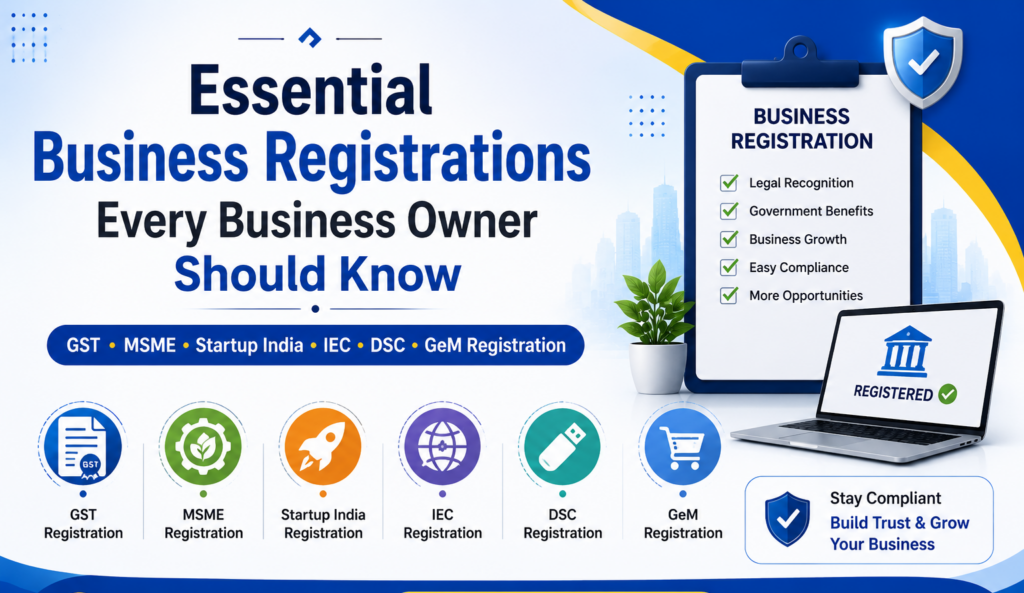
Registering your business entity is only the first step toward operating a legally compliant business in India. Depending on the nature of your business, turnover, products, services, and future expansion plans, you may also need additional registrations and certifications.
These registrations help businesses comply with tax laws, access government schemes, participate in government tenders, expand internationally, and build credibility among customers and financial institutions.
Below are the most important registrations every entrepreneur should know about.
GST Registration
Goods and Services Tax (GST) Registration is one of the most important tax registrations for businesses operating in India. Businesses that cross the prescribed turnover threshold or engage in specific taxable activities are required to register under GST.
GST registration allows businesses to collect GST from customers, claim Input Tax Credit (ITC), and comply with indirect tax regulations. It also improves business credibility and enables interstate trade without unnecessary restrictions.
GST Registration is generally suitable for:
- Manufacturers
- Traders
- Service Providers
- E-commerce Sellers
- Exporters
- Importers
Read More: GST Registration
MSME (Udyam) Registration
MSME Registration, also known as Udyam Registration, is a government recognition provided to Micro, Small, and Medium Enterprises. Although it is generally voluntary, registering as an MSME provides access to various government benefits, easier bank loans, subsidies, and priority lending schemes.
MSME registration also improves business credibility and helps enterprises participate in government procurement programs.
MSME Registration is beneficial for:
- Startups
- Manufacturers
- Small Businesses
- Service Providers
- Traders
Read More: MSME Registration
Startup India Registration
The Startup India Initiative was launched by the Government of India to promote innovation, entrepreneurship, and employment generation. Eligible startups can obtain DPIIT recognition and enjoy various benefits, including tax exemptions, easier compliance, government funding opportunities, and participation in startup programs.
Businesses planning rapid growth and innovation should consider Startup India Registration at an early stage.
Best suited for:
- Technology Startups
- Innovative Businesses
- SaaS Companies
- FinTech Startups
- AI Startups
Read More: Startup India Initiative
Import Export Code (IEC) Registration
Businesses involved in importing or exporting goods and services generally require an Import Export Code (IEC) issued by the Directorate General of Foreign Trade (DGFT).
Without an IEC, businesses may face restrictions while conducting international trade. The registration process is completely online and helps businesses expand into global markets.
IEC Registration is recommended for:
- Exporters
- Importers
- Manufacturers
- International Traders
- E-commerce Exporters
Read More: Import Export Code (IEC)
Digital Signature Certificate (DSC)
A Digital Signature Certificate (DSC) is an electronic signature used for securely signing online documents and filing forms with government authorities. It is mandatory for many MCA, GST, Income Tax, and DGFT filings.
Directors, partners, business owners, and authorized signatories often require a DSC to complete online registrations and annual compliance filings.
Read More: Digital Signature Certificate (DSC)
Government e-Marketplace (GeM) Registration
The Government e-Marketplace (GeM) is an online procurement platform where businesses can sell products and services directly to government departments, ministries, and public sector organizations.
GeM Registration increases business opportunities by allowing sellers to participate in government procurement and tenders.
GeM Registration is suitable for:
- Manufacturers
- Traders
- Service Providers
- MSMEs
- Startups
Read More: Government e-Marketplace (GeM)
Which Registrations Does Your Business Need?
The required registrations depend on your business activities, legal requirements, and future growth plans. The table below helps you identify the most suitable registrations for your business.
| Registration | Recommended For |
|---|---|
| GST Registration | Businesses liable under GST laws |
| MSME Registration | Micro, Small & Medium Enterprises |
| Startup India Registration | Eligible Startups |
| IEC Registration | Import & Export Businesses |
| Digital Signature Certificate (DSC) | MCA, GST & Income Tax Filings |
| GeM Registration | Businesses Selling to Government |
📚 Related Guides
You can explore these detailed registration guides:
- GST Registration
- MSME Registration
- Startup India Registration
- Import Export Code (IEC) Registration
- Digital Signature Certificate (DSC)
- GeM Registration
Documents Required for Business Registration in India : Complete Guide
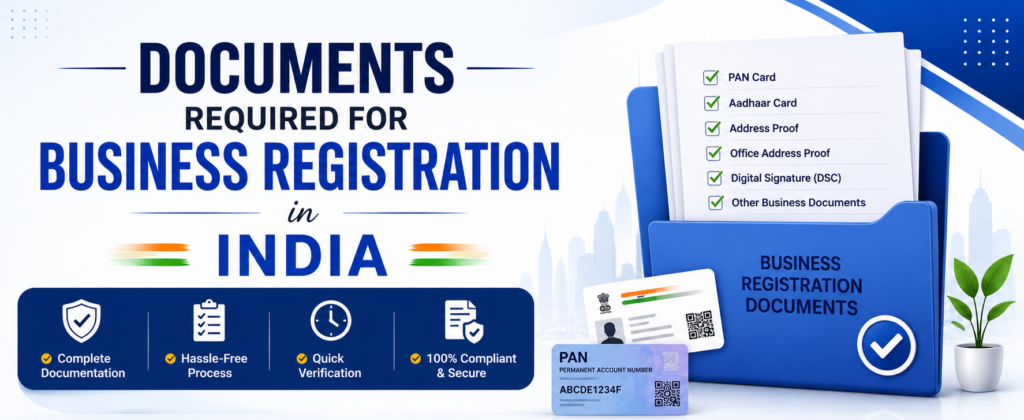
Registering a business in India requires submitting specific documents to the relevant government authorities. The exact documentation depends on the type of business structure you choose, such as a Private Limited Company, LLP, Partnership Firm, or Proprietorship Firm. In addition, registrations like GST, MSME, Startup India, and IEC may require separate supporting documents.
Keeping all documents ready before starting the registration process helps avoid delays and ensures a smoother application experience.
Common Documents Required for Business Registration
The following documents are commonly required for most business registrations in India:
Identity Proof
Every business owner, director, partner, or proprietor must provide a valid government-issued identity proof.
Commonly accepted documents include:
- Aadhaar Card
- PAN Card
- Passport
- Voter ID
- Driving Licence
These documents are used to verify the identity of the applicant during the registration process.
Address Proof
Applicants must also submit proof of their residential address.
Accepted documents generally include:
- Aadhaar Card
- Passport
- Driving Licence
- Recent Electricity Bill
- Bank Statement
- Telephone Bill
The address proof should be valid and match the applicant’s current residential address.
PAN Card
A Permanent Account Number (PAN) is mandatory for almost every type of business registration in India. Companies and LLPs receive a separate PAN after incorporation, while proprietorship businesses generally use the proprietor’s PAN.
Passport-size Photographs
Recent passport-size photographs of directors, partners, or proprietors may be required depending on the type of registration.
Business Address Proof
Every registered business must provide proof of its office or business address.
Common documents include:
- Electricity Bill
- Water Bill
- Property Tax Receipt
- Rent Agreement
- Lease Agreement
If the premises are rented, a No Objection Certificate (NOC) from the property owner may also be required.
Digital Signature Certificate (DSC)
For registrations through the Ministry of Corporate Affairs (MCA), directors are generally required to obtain a Digital Signature Certificate (DSC) to sign electronic forms.
👉 Read our complete guide on Digital Signature Certificate (DSC) to understand its benefits, validity, and application process.
Business-Specific Documents
Certain business registrations require additional documents depending on the nature of the business.
Examples include:
- Partnership Deed
- Memorandum of Association (MOA)
- Articles of Association (AOA)
- LLP Agreement
- Board Resolution
- Incorporation Certificate
- GST-related documents
- Import Export Code (IEC) documents
These requirements vary based on the chosen business structure.
Documents Required for Different Business Structures
The document requirements differ depending on the business entity. The table below provides an overview of the commonly required documents for each business structure.
| Business Type | Common Documents Required |
|---|---|
| Private Limited Company | PAN Card, Aadhaar Card, Address Proof, Passport-size Photos, Office Address Proof, DSC |
| LLP | PAN Card, Aadhaar Card, Address Proof, Office Address Proof, DSC |
| One Person Company (OPC) | PAN Card, Aadhaar Card, Address Proof, Office Address Proof |
| Partnership Firm | PAN Card, Aadhaar Card, Partnership Deed, Address Proof |
| Proprietorship Firm | PAN Card, Aadhaar Card, Address Proof, GST/MSME Registration (if applicable) |
| Section 8 Company | PAN Card, Aadhaar Card, MOA, AOA, Office Address Proof |
| Producer Company | PAN Card, Aadhaar Card, Agricultural Member Details, Address Proof |
Tips Before Submitting Documents
Before uploading your documents, ensure that:
- All documents are clear and legible.
- Names match across all identity documents.
- PAN and Aadhaar details are accurate.
- Address proof is recent and valid.
- Passport-size photographs are updated.
- Office address documents are complete and correctly signed.
- Digital copies are scanned in high quality.
Preparing your documents in advance helps reduce processing time and minimizes the chances of application rejection.
Need Help Preparing Your Registration Documents?
Our experts will verify your documents and complete your business registration quickly & hassle-free.
📚 Related Guides
Explore our detailed registration guides for document-specific requirements:
Private Limited Company Registration
One Person Company (OPC) Registration
Proprietorship Firm Registration
Digital Signature Certificate (DSC)
Step-by-Step Business Registration Process in India : Complete Guide 2026
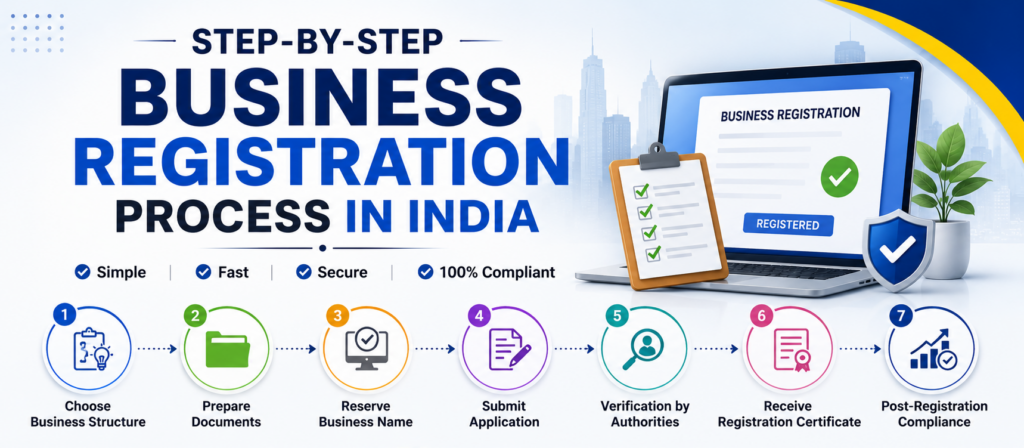
Registering a business in India has become much easier with the introduction of online government portals and digital documentation. However, the exact registration process depends on the type of business structure you choose, such as a Private Limited Company, LLP, Proprietorship Firm, Partnership Firm, or One Person Company (OPC).
Following the correct registration process helps avoid delays, document rejections, and future legal complications. Below is a general step-by-step process applicable to most business registrations in India.
Step 1: Choose the Right Business Structure
The first and most important step is selecting a suitable business structure based on your business goals, ownership pattern, investment plans, taxation, and compliance requirements.
Some of the most popular business structures include:
- Private Limited Company
- Limited Liability Partnership (LLP)
- One Person Company (OPC)
- Partnership Firm
- Proprietorship Firm
- Section 8 Company
- Producer Company
Choosing the right entity at the beginning helps reduce future legal and tax complications.
👉 Read our detailed guide on choosing the right business structure for your business.
- Private Limited Company Registration
- LLP Registration
- OPC Registration
- Partnership Firm Registration
- Proprietorship Firm Registration
Step 2: Prepare the Required Documents
Once you’ve selected the business structure, gather all the required documents before starting the registration process.
Common documents generally include:
- PAN Card
- Aadhaar Card
- Address Proof
- Passport-size Photographs
- Office Address Proof
- Email ID & Mobile Number
- Digital Signature Certificate (if applicable)
Preparing complete and accurate documents in advance helps avoid unnecessary delays during verification.
Step 3: Reserve the Business Name
Most registered business entities require approval of their proposed business name before incorporation.
The selected name should:
- Be unique
- Follow government naming guidelines
- Avoid trademark conflicts
- Reflect the nature of the business
A properly chosen business name helps build your brand identity and reduces the chances of application rejection.
Step 4: Submit the Registration Application
After preparing the documents and selecting the business name, the registration application must be submitted through the relevant government portal.
Depending on the business structure, the application may be filed with:
- Ministry of Corporate Affairs (MCA)
- Registrar of Firms
- GST Portal
- Udyam Registration Portal
- DGFT Portal
Ensure all details are accurate before submission to avoid processing delays.
Step 5: Verification by Government Authorities
After submission, the concerned government department reviews the application and verifies the documents.
During verification, authorities may:
- Verify applicant identity
- Check business address
- Review uploaded documents
- Request additional clarification (if required)
Responding promptly to any queries helps speed up the approval process.
Step 6: Receive the Registration Certificate
Once the application is approved, the government issues the relevant registration certificate.
Depending on the registration type, you may receive:
- Certificate of Incorporation
- LLP Certificate
- GST Certificate
- MSME (Udyam) Certificate
- Startup India Recognition
- IEC Certificate
The certificate serves as official proof that your business has been legally registered.
Step 7: Complete Post-Registration Compliance
Business registration is only the beginning. After registration, businesses must complete various statutory and tax-related compliances depending on the chosen business structure.
These may include:
- GST Return Filing
- ROC Annual Filing
- Income Tax Return
- Accounting & Bookkeeping
- Appointment of Auditor
- Director KYC Compliance
- Annual Compliance
Maintaining regular compliance helps avoid penalties and keeps the business legally compliant.
👉 Read our detailed guides on Annual ROC Compliance and Director Compliance.
Estimated Timeline for Business Registration
The registration timeline varies depending on the business structure and document verification.
| Business Registration | Estimated Timeline |
|---|---|
| Proprietorship Firm | 1–3 Working Days |
| Partnership Firm | 5–7 Working Days |
| LLP Registration | 7–10 Working Days |
| OPC Registration | 7–10 Working Days |
| Private Limited Company | 7–10 Working Days |
| Section 8 Company | 15–20 Working Days |
| Producer Company | 10–15 Working Days |
Common Mistakes to Avoid During Business Registration
To ensure a smooth registration process, avoid these common mistakes:
- Choosing the wrong business structure
- Submitting incomplete documents
- Entering incorrect PAN or Aadhaar details
- Selecting a business name that violates government guidelines
- Ignoring post-registration compliances
- Delaying GST or MSME registration when applicable
Taking professional assistance can help reduce errors and speed up the registration process.
Need Help Registering Your Business?
Our legal experts can help you choose the right business structure, prepare documents, and complete your business registration quickly, accurately, and hassle-free.
📚 Related Guides
Explore these detailed guides for step-by-step registration assistance:
- Annual ROC Filing
- Private Limited Company Registration
- LLP Registration
- One Person Company (OPC) Registration
- Partnership Firm Registration
- Proprietorship Firm Registration
- GST Registration
- MSME Registration
- Startup India Registration
- Digital Signature Certificate (DSC)
Legal Compliance After Business Registration in India
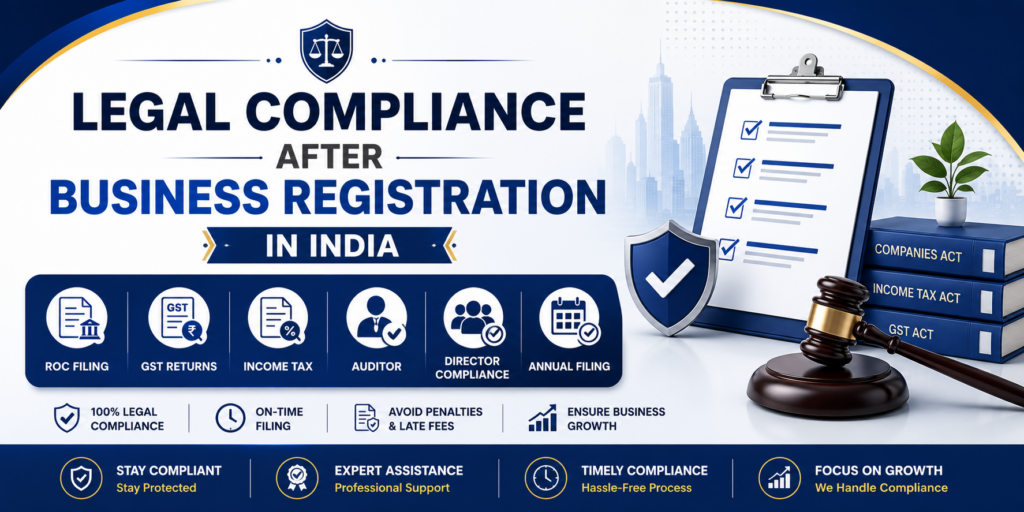
Registering your business is only the beginning of your entrepreneurial journey. After incorporation or registration, every business must comply with various legal, tax, and regulatory requirements to remain operational and avoid penalties. The compliance requirements depend on the type of business entity, annual turnover, business activities, and applicable laws.
Whether you operate a Private Limited Company, LLP, OPC, Partnership Firm, or Proprietorship Firm, staying compliant helps maintain your business’s legal status, improves credibility, and supports long-term growth.
Why Is Business Compliance Important?
Legal compliance ensures that your business operates according to the laws and regulations applicable in India. Failure to comply with statutory requirements may result in penalties, legal notices, additional government fees, or even the striking off of the business in certain cases.
Maintaining compliance also helps businesses:
- Build trust with customers and investors
- Maintain a good legal standing
- Avoid penalties and late fees
- Improve eligibility for loans and government schemes
- Participate in government tenders
- Support future business expansion
Major Legal Compliances for Businesses
Depending on your business structure, you may need to complete the following compliances.
Annual ROC Filing
Companies and LLPs are required to file annual returns and financial statements with the Ministry of Corporate Affairs (MCA). Timely ROC filing helps maintain active company status and avoids additional filing fees and penalties.
Regular ROC compliance is essential even if the company has not carried out significant business operations during the financial year.
👉 Learn more about Annual ROC Filing, due dates, forms, and penalties.
GST Return Filing
Businesses registered under GST must file GST returns within the prescribed due dates. The type and frequency of returns depend on the registration category and turnover.
Timely GST return filing helps businesses claim Input Tax Credit (ITC), remain tax compliant, and avoid interest and late fees.
👉 Read our complete GST Return Filing guide.
Income Tax Return (ITR)
Every eligible business must file Income Tax Returns based on the applicable provisions of the Income Tax Act. Filing returns on time helps businesses remain compliant and reduces the risk of penalties.
Proper bookkeeping and accounting records are essential for accurate tax filing.
Appointment of Auditor
Certain companies are required to appoint an auditor after incorporation in accordance with the Companies Act, 2013. The auditor is responsible for examining financial statements and ensuring compliance with applicable accounting standards.
👉 Read our detailed guide on Appointment of Auditor.
Appointment of Director
As businesses grow, they may need to appoint additional directors to strengthen management or comply with statutory requirements.
The appointment must follow the procedures prescribed under the Companies Act, 2013.
👉 Learn the complete Appointment of Director process.
DIR-3 KYC Compliance
Every individual holding a Director Identification Number (DIN) is generally required to complete DIR-3 KYC as prescribed by the Ministry of Corporate Affairs.
Failure to complete DIR-3 KYC within the applicable timeline may result in DIN deactivation and additional government fees.
👉 Read our DIR-3 KYC guide.
Bookkeeping and Accounting
Maintaining proper books of accounts is essential for every business. Accurate bookkeeping helps businesses prepare financial statements, calculate taxes, manage cash flow, and meet statutory compliance requirements.
Good accounting practices also simplify audits and financial reporting.
Business License Renewals
Depending on the nature of the business, various licenses and registrations may require periodic renewal.
Examples include:
- Trade License
- Shop & Establishment Registration
- FSSAI License
- Professional Tax Registration
- Labour License
Businesses should regularly monitor renewal dates to avoid disruptions.
Compliance Checklist for Business Owners
After business registration, maintaining legal compliance is essential to avoid penalties and keep your business running smoothly. The table below highlights some of the key compliance requirements.
| Compliance | Applicable To | Frequency |
|---|---|---|
| ROC Annual Filing | Companies & LLPs | Annual |
| GST Return Filing | GST Registered Businesses | Monthly / Quarterly / Annual |
| Income Tax Return | Eligible Businesses | Annual |
| Appointment of Auditor | Companies | As Required |
| DIR-3 KYC | Company Directors | Annual |
| Bookkeeping & Accounting | All Businesses | Regular |
| License Renewals | Applicable Businesses | As Applicable |
Consequences of Non-Compliance
Ignoring legal compliance can lead to several problems, including:
- Government penalties
- Additional filing fees
- Legal notices
- Cancellation of registrations
- Loss of business credibility
- Difficulty obtaining loans or investments
- Restrictions on future business expansion
Maintaining timely compliance helps businesses avoid these risks and ensures smooth operations.
Need Help with Business Compliance?
Managing legal compliance can be challenging, especially for growing businesses. Our experienced professionals can assist you with ROC filings, GST returns, annual compliance, auditor appointments, director compliance, and other statutory requirements.
📞 Call Now: 9911930022
Business Registration Cost, Government Fees, Timeline & Common Mistakes
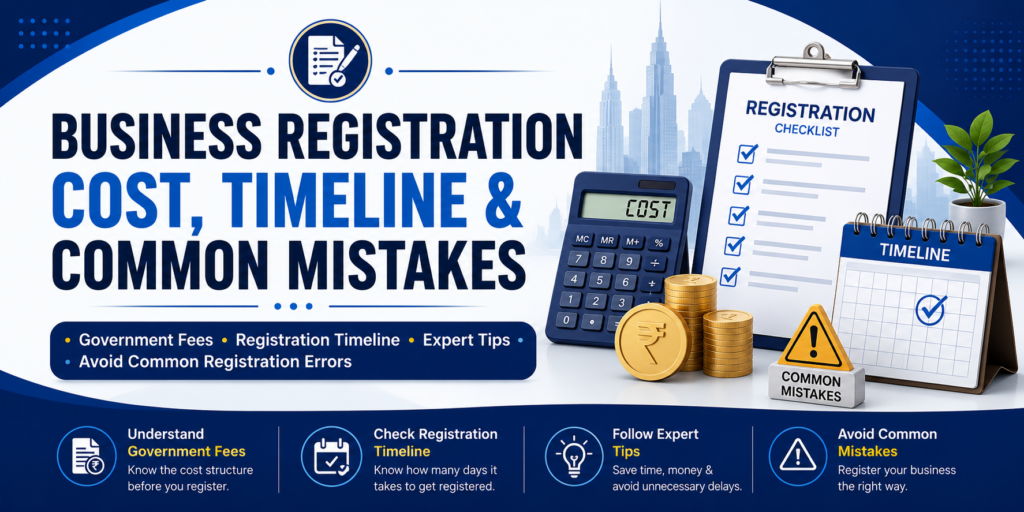
The cost of business registration in India depends on the type of business entity, government filing fees, professional charges, state-specific requirements, and additional registrations such as GST or MSME. Understanding the estimated cost, registration timeline, and common mistakes can help entrepreneurs plan their business setup more effectively and avoid unnecessary delays.
Business Registration Cost in India
The registration cost varies based on the business structure you choose. Government fees may differ depending on factors such as authorized capital, state regulations, stamp duty, and the applicable registration process.
Apart from government fees, businesses may also incur professional service charges for documentation, legal assistance, digital signatures, and compliance support.
Before starting the registration process, it is advisable to understand all applicable costs to avoid unexpected expenses.
Need a personalized quotation? Contact our experts for a business registration cost estimate based on your requirements.
Government Fees for Business Registration
Government filing fees are determined by the respective government authorities and may change from time to time. The fees depend on various factors, including:
- Type of business entity
- Authorized share capital (for companies)
- Stamp duty applicable in the state
- Number of directors or partners
- Digital Signature Certificate (DSC) requirements
- Additional registrations, if applicable
Since fee structures may vary, businesses should always verify the latest government charges before filing an application.
Estimated Registration Timeline
The registration timeline depends on document verification, government processing, application accuracy, and the chosen business structure.
| Business Registration | Estimated Timeline |
|---|---|
| Proprietorship Firm | 1–3 Working Days |
| Partnership Firm | 5–7 Working Days |
| LLP Registration | 7–10 Working Days |
| One Person Company (OPC) | 7–10 Working Days |
| Private Limited Company | 7–10 Working Days |
| Producer Company | 10–15 Working Days |
| Section 8 Company | 15–20 Working Days |
Factors That Affect Registration Time
Several factors can influence how quickly your business registration is completed.
These include:
- Incomplete documentation
- Incorrect application details
- Business name rejection
- Delayed government verification
- Additional document requests
- State-specific approval procedures
Submitting complete and accurate information significantly reduces the chances of delays.
Common Mistakes to Avoid During Business Registration
Many entrepreneurs face delays or application rejections because of avoidable mistakes. Being aware of these issues can help ensure a smoother registration process.
Choosing the Wrong Business Structure
Selecting an unsuitable business entity may increase compliance costs and create operational challenges in the future.
👉 Read More
Private Limited Company Registration
Proprietorship Firm Registration
Using an Already Registered Business Name
Your proposed business name should comply with government naming guidelines and should not conflict with existing registered businesses or trademarks.
Submitting Incorrect Documents
Uploading incomplete, outdated, or incorrect documents is one of the most common reasons for registration delays.
Before submission, verify:
- PAN details
- Aadhaar details
- Address proof
- Office proof
- Contact information
Ignoring GST Registration Requirements
Some businesses are required to obtain GST Registration based on turnover, business activities, or legal provisions. Delaying GST registration may lead to compliance issues.
👉 Read More
Skipping MSME Registration
Although MSME Registration is generally voluntary, eligible businesses may benefit from government schemes, easier financing, and other incentives.
👉 Read More
Delaying Post-Registration Compliance
Many business owners believe registration is the final step. However, businesses must continue meeting annual compliance requirements, including ROC filings, GST returns, and income tax obligations.
👉 Read More
- Annual ROC Filing
- GST Return Filing
- Appointment of Auditor
Tips for a Smooth Registration Process
To make your business registration process faster and hassle-free:
- Choose the right business structure.
- Keep all required documents ready.
- Verify all information before submission.
- Select a unique business name.
- Complete applicable GST and MSME registrations.
- Track application status regularly.
- Stay compliant after registration.
Following these best practices helps reduce delays and improves the chances of quick approval.
Need Expert Assistance with Business Registration?
Whether you’re starting a Private Limited Company, LLP, OPC, Partnership Firm, or Proprietorship Firm, our professionals can guide you through every step of the registration process—from documentation to government approvals and post-registration compliance.
📞 Call Now: 9911930022
Frequently Asked Questions (FAQs)
1. What is business registration?
Business registration is the legal process of establishing a business under the applicable laws in India. It gives your business legal recognition and allows you to operate lawfully
2. Which business registration is best in India?
The best business structure depends on your business goals. Private Limited Companies are often chosen for startups seeking investment, while LLPs, OPCs, Partnerships, and Proprietorships may suit other business needs.
3. Can I register a business online?
Yes. Most business registrations in India can be completed online through the respective government portals, subject to document verification and approval.
4. What documents are required for business registration?
Commonly required documents include:
- PAN Card
- Aadhaar Card
- Address Proof
- Passport-size Photograph
- Office Address Proof
- Digital Signature Certificate (where applicable)
👉 Read More: Documents Required for Business Registration
5. Is GST registration mandatory?
GST registration is required only for businesses that meet the prescribed eligibility criteria or engage in activities where GST registration is compulsory.
👉 Read More: GST Registration
6. Is MSME Registration compulsory?
No. MSME (Udyam) Registration is generally voluntary, but eligible businesses can access various government benefits and support schemes.
👉 Read More: MSME Registration
7. How long does business registration take?
The timeline depends on the business structure, document verification, and government processing. Many registrations are completed within a few working days, while others may take longer.
8. What is the cost of business registration?
The registration cost varies depending on the business structure, government fees, state-specific charges, and professional services.
9. What compliances are required after business registration?
Depending on the business type, compliances may include GST return filing, ROC filing, income tax return filing, bookkeeping, and annual statutory filings.
👉 Read More: Annual ROC Filing
10. Why choose Growup India for business registration?
Growup India provides professional assistance for company registration, GST, MSME, Startup India, ROC compliance, and other business registration services with end-to-end support.
Conclusion
Starting a business in India begins with choosing the right business structure and completing the required registrations. Whether you opt for a Private Limited Company, LLP, OPC, Partnership Firm, or Proprietorship Firm, selecting the appropriate entity is essential for smooth operations and long-term growth.
In addition to business registration, businesses may also need registrations such as GST, MSME (Udyam), Startup India, IEC, and GeM, depending on their activities and eligibility. Timely compliance with legal and tax requirements also helps avoid penalties and ensures uninterrupted business operations.
This guide has covered the key aspects of business registration in India, including business structures, required documents, registration process, legal compliances, costs, timelines, and frequently asked questions. For detailed information on any specific topic, explore the related guides linked throughout this page.
Need Professional Assistance?
If you’re planning to register a business in India, our experts are here to help. We provide end-to-end assistance for company registration, GST registration, MSME registration, Startup India registration, ROC compliance, and other business-related legal services.
Our Services Include:
- Private Limited Company Registration
- LLP Registration
- One Person Company (OPC) Registration
- Partnership Firm Registration
- Proprietorship Firm Registration
- GST Registration
- MSME Registration
- Startup India Registration
- Annual ROC Compliance
📞 Call Us: 9911930022
Ready to start your business? Contact Growup India today and let our experts simplify your business registration process.
Need Help?
Our business registration experts are here to help you with Company Registration, GST Registration, MSME Registration, LLP Registration, Startup India Registration, and other legal compliance services.
Contact Our Experts